Audemars Piguet Resale Value 2026 Royal Oak Investment Guide For Buyers
Audemars Piguet resale value in 2026 depends on the exact Royal Oak reference, condition and market cycle. Compare Jumbo history and Royal Oak vs Offshore.
Audemars Piguet Resale Value 2026: The Short Answer
Audemars Piguet resale value is strongest in the steel Royal Oak family, but the reference, dial, condition and set matter more than the badge alone. A discontinued Jumbo 15202ST and a standard Royal Oak Offshore are not interchangeable resale propositions.
The market’s clearest recent lesson is the steel Royal Oak 15202ST. WatchCharts recorded the blue-dial 15202ST at roughly US$122,000 at its March 2022 peak and around US$56,000 in late 2025. Chrono24 also cited approximately €137,000 in early 2022 and about €80,000 by March 2023.
That still left the 15202 materially above its final retail price of just under €25,000 in 2022. It does not prove that every discontinued Royal Oak is an investment. The 2022 peak coincided with a broader watch-market boom, so it is not possible to separate the effect of discontinuation cleanly from market-wide speculation.
For a buyer in Dubai, Riyadh, Kuwait City or Doha, the practical point is simpler: buy the exact Royal Oak you would be happy to wear if the
Royal Oak vs Royal Oak Offshore: Which Holds Value Better?
The Royal Oak and Royal Oak Offshore share a name, not the same buyer pool. A useful Royal Oak resale price comparison looks at completed sales of the same reference, not two unrelated asking prices. Royal Oak Offshore value also depends on its size, configuration and condition; a lower listing price alone is not evidence of better retention.
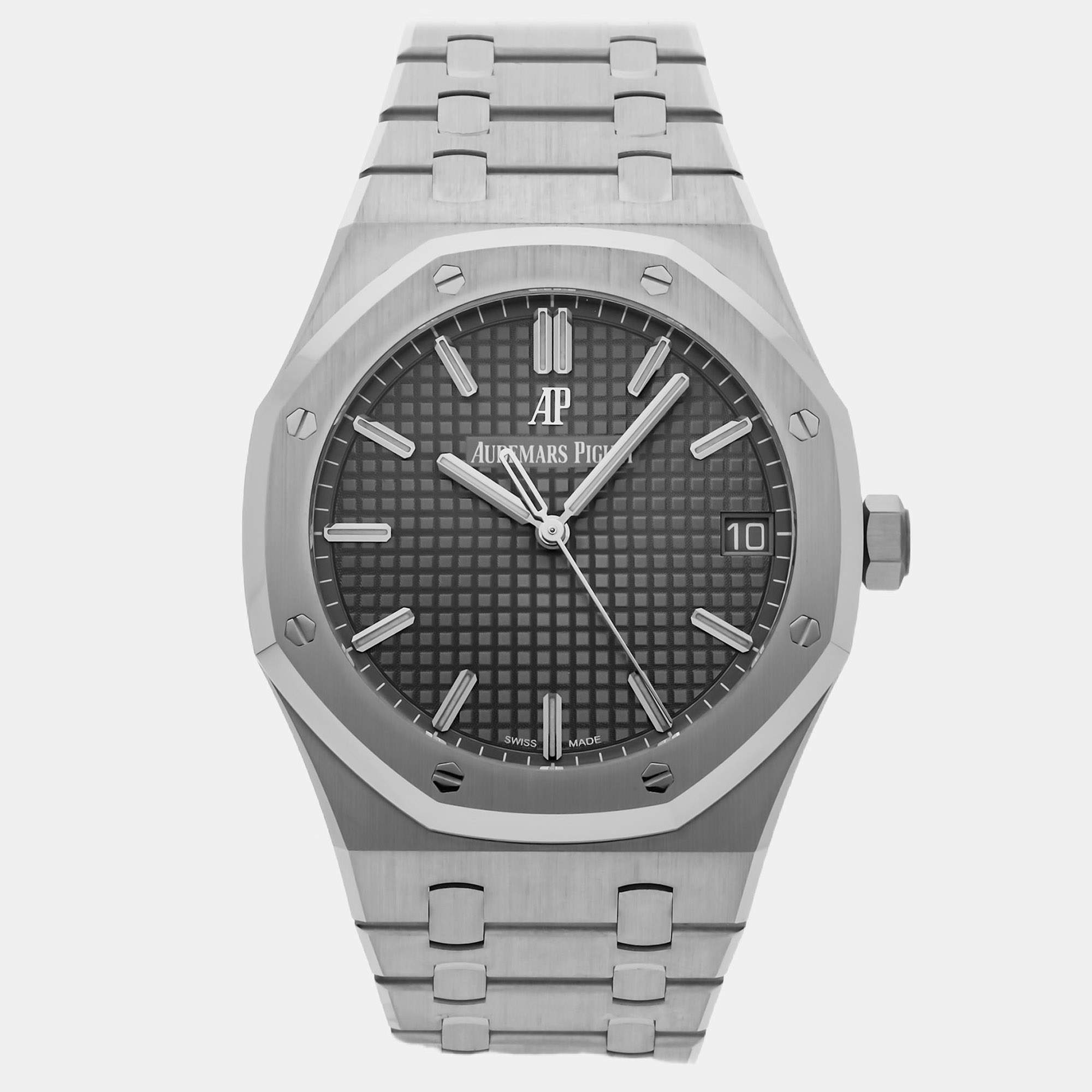
The Royal Oak is Audemars Piguet’s defining integrated-bracelet sports watch: octagonal bezel, exposed hexagonal screws and tapisserie dial. The Offshore, introduced in 1993, takes that vocabulary into a larger, more overtly sporting format.
The Royal Oak has broad collector recognition, but the supplied evidence does not establish which line is more liquid. Judge any two watches by reference, condition and comparable completed sales.
| Consideration | Royal Oak | Royal Oak Offshore |
|---|---|---|
| Core appeal | Integrated-bracelet sports watch with the design most closely associated with AP | Larger, more technical and more overtly sporty interpretation of the Royal Oak |
| Key resale drivers | Reference, dial, bracelet condition, completeness and collector demand | Reference, case size, material, condition, service history and buyer fit |
| Buyer risk | Paying a premium for hype rather than the specific watch | Assuming a lower entry price automatically means stronger value retention |
| Best use case | Buyer prioritising classic AP design and broad collector recognition | Buyer who genuinely prefers the Offshore’s proportions and wrist presence |
Why the reference matters more than the family name
A buyer comparing a Royal Oak with an Offshore should not rely on headline prices alone. A watch can have a lower asking price and still be harder to resell if it has a narrower audience, extensive polishing, missing paperwork or an expensive service requirement.
The same applies within the Royal Oak line. A steel watch with a sought-after dial can attract very different demand from a precious-metal, diamond-set or less conventional configuration. That is preference, not a universal hierarchy.
Compare actual sales, not asking prices
A resale-retention figure should compare completed sales for the same reference over a defined period, with condition and completeness accounted for. A steel Royal Oak, a diamond-set Royal Oak and an Offshore chronograph are not interchangeable comparables.
Before deciding which watch better protects your budget, check:
- The exact reference and configuration: case material, dial, size and movement all change the comparison set.
- Completed transactions: asking prices show what sellers hope to receive, not what buyers paid.
- Condition and accompanying set: polishing, service history, bracelet wear, box and papers affect the outcome.
- Net proceeds and time to sale: dealer margin, service costs and how long a watch takes to sell matter alongside its headline price.
Do not describe one line as a better investment without comparable completed-sale evidence.
The Royal Oak References Buyers Should Understand
Royal Oak “Jumbo” 15202ST and 16202
The 15202ST is the best-known modern successor to the original Royal Oak. Its collector appeal rests partly on its 39mm proportions, Petite Tapisserie dial and lack of a central seconds hand.
Its discontinuation created genuine scarcity, but the market history demands restraint. The 15202ST’s extraordinary 2022 peak later corrected sharply alongside the wider secondary watch market. The remaining premium is meaningful; the peak was not a stable baseline.
The current 16202 continues the Jumbo format. At a glance, it retains the fine Petite Tapisserie dial and no central seconds hand. It also uses a hand-applied AP emblem at 6 o’clock, with the printed Audemars Piguet name at 12 o’clock.
Buyer takeaway: A Jumbo should be bought for its design and reference-specific appeal, not because “discontinued” is treated as a shortcut to guaranteed profit.
Royal Oak 15400, 15500 and 15510
Among 41mm Royal Oaks, the dial is a practical way to distinguish generations.
- 15400: Double baton at 12 o’clock and an “Automatic” inscription on the dial.
- 15500: Central seconds hand, Grande Tapisserie dial and a minute track on an outer ring. The “Automatic” inscription was removed.
- 15510: Tapisserie continues across the dial without a separate minute-track ring. Its hour markers are thinner and longer, and the dial carries the full Audemars Piguet wordmark rather than the AP logo.
The bezel screws do not identify the generation. The eight hexagonal screws are a defining Royal Oak feature across generations.
Royal Oak 15550
The 15550 is a 37mm Royal Oak, not a 41mm model. That distinction matters. Case size changes the buyer pool, wrist fit and comparables, so it should never be grouped mechanically with the 41mm references in a pricing table.
How Condition Changes Royal Oak Resale Value
Condition is not cosmetic on a Royal Oak. It directly affects resale confidence and, often, resale price.
The Royal Oak’s integrated bracelet and sharply defined case finishing make careless polishing especially costly. A refinished watch may look bright in a listing photograph while losing the crisp transitions that make the original design read correctly on the wrist.
What to inspect before accepting a Royal Oak
Before a Royal Oak is accepted for resale, the team should assess details that are easy to miss in a casual marketplace listing:
- Bezel and case geometry: Over-polishing can soften the octagonal bezel’s edges and alter the intended satin and polished finishes.
- Bracelet stretch and link condition: An integrated bracelet is central to both wearability and value. Excessive play, damaged links or mismatched finishing require closer review.
- Dial and hands: Tapisserie texture, printing, luminous material and handset should be consistent with the reference and production period.
- Movement and reference consistency: The movement, case, dial and bracelet must make sense together for the stated watch.
- Service history: A documented manufacturer or reputable specialist service can be useful. Undocumented replacement parts or poor refinishing can weaken collector appeal.
- Box, papers and sales documentation: These do not make an inauthentic watch authentic, but a complete set can make a legitimate watch easier to place with a cautious buyer.
A box and papers set is helpful, especially on high-value references. It is not a substitute for authentication.
AP Resale Retention: What Buyers Should Actually Compare
A resale-retention percentage is only useful when the starting price is clear.
Comparing a completed resale price with a current boutique price can create a misleading result if retail increased after the watch was sold. Comparing against a seller’s claimed purchase price is worse. Use the documented official retail price at the time of first sale where available, then adjust the interpretation for taxes, service costs, dealer margin and transaction fees.
A practical AP investment guide
Treat a Royal Oak as a wearable luxury asset with resale potential, not a guaranteed financial investment.
Before paying above retail, ask:
- What is the exact reference? “Steel Royal Oak” is not precise enough.
- What comparable watches actually sold? Ignore optimistic asking prices.
- Is the watch complete? Confirm box, papers, warranty documentation and service records where available.
- Has the case or bracelet been heavily polished? Request clear macro images of the bezel, case flanks and bracelet.
- Is the premium explained by lasting collector demand or a short-term event?
- Can you afford to hold it? A resale decision made under time pressure usually weakens the seller’s negotiating position.
What Discontinuation Can — and Cannot — Do for Value
Discontinuation limits future supply. It does not automatically create durable demand.
The 15202ST shows both sides of the argument. The end of production coincided with collector attention, yet its record-high market prices arrived during a wider period of exceptional speculation across sought-after watches. When that market corrected, much of the excess premium disappeared.
A better rule is this: discontinuation can support a strong reference; it cannot rescue a weak buying decision.
Royal Oak History: The Detail Most Retellings Miss
The Royal Oak did not go from an overnight sketch directly to a 1972 launch.
Georges Golay asked Gérald Genta for a radically different steel sports-watch design on the eve of the 1970 Basel fair. The overnight sketch was the beginning, not the completed watch. Audemars Piguet’s archive records that a full year had passed by April 1971, and that a patent application was filed on 6 December 1971 with Genta named as inventor. The Royal Oak debuted in 1972.
Its launch price was 3,650 Swiss francs, according to Audemars Piguet’s archive. That placed a stainless-steel watch in gold dress-watch territory and prompted considerable trade scepticism.
That context matters because it explains what collectors still respond to: the Royal Oak was not designed as an affordable steel alternative. It was designed to make steel feel architecturally precious.
Buying an Audemars Piguet in the GCC
GCC buyers should avoid simplistic regional assumptions about colour or metal preference. There is not sufficient evidence here to claim that rose gold or two-tone Royal Oaks outperform steel in Saudi Arabia, Kuwait, Qatar or the UAE.
Dubai’s market is highly international, with demand shaped by global collector preferences as much as local taste. In Riyadh, provenance, heritage and discreet collecting can matter deeply to individual buyers, but that is not evidence that one metal or dial configuration will always resell better than another.
The useful local advantage is practical: inspect the exact watch, understand its condition and transact through a platform that can authenticate it before it reaches the next owner.
How to Buy or Sell a Royal Oak Through The Luxury Closet
For buyers, start with TLC’s Audemars Piguet watch listings and narrow the search to Royal Oak watches. Compare only like-for-like references. Ask for condition images that show the bezel, bracelet and dial clearly. Do not compare a complete, unpolished watch with a watch of unknown service history simply because both share a reference number.
Compare current Royal Oak and Offshore listings
The six linked Audemars Piguet pieces below show the range of Royal Oak and Offshore references currently surfaced by TLC’s catalogue. Use the product images and reference numbers to compare design, dimensions and condition; confirm availability and details on each listing before making a decision. These are examples, not comparable completed-sale prices.
For sellers, provide every available item at intake: watch, box, papers, warranty documentation, service receipts and any replaced parts. Accurate disclosure gives the authentication team a cleaner starting point and helps establish a more credible resale assessment.
Frequently asked questions
Does an Audemars Piguet Royal Oak hold its value?
It depends heavily on the exact reference, dial, condition and completeness rather than the badge alone. The steel 15202ST is the clearest case study: WatchCharts recorded it near $122,000 at its March 2022 peak and around $56,000 in late 2025, yet that is still well above its final retail price of just under €25,000. The lesson is that discontinuation and collector demand can support a durable premium, but they do not guarantee it holds at peak levels.
Is the Royal Oak Offshore a good investment compared to the standard Royal Oak?
The supplied evidence does not establish which line is more liquid. An Offshore’s resale outcome depends on its reference, size, material, condition and actual buyer demand, so do not assume it will track steel Royal Oak prices. Compare completed sales of the exact watches you are considering.
Is the Audemars Piguet 16202 discontinued?
No. The 16202 is a Royal Oak Jumbo reference introduced in 2022 as the successor to the discontinued 15202ST. It retains the fine Petite Tapisserie dial and lack of a central seconds hand.
How can I tell a Royal Oak 15400 from a 15500 at a glance?
The 15400 has a double baton marker at 12 o’clock and keeps the “Automatic” inscription on the dial. The 15500 removed that inscription, added a central seconds hand and prints its minute track on an outer ring of the Grande Tapisserie dial. The bezel’s eight hexagonal screws are common to both, so they will not help you date the reference.
Do box and papers increase Royal Oak resale value?
A complete set can make a legitimate watch easier to place with a cautious buyer, particularly at higher price points, so it is a practical advantage at resale. It is not proof of authenticity on its own, and missing paperwork does not automatically mean a watch is inauthentic. Authentication should always be verified independently of documentation.
Does polishing affect Royal Oak resale value?
Yes. The Royal Oak’s sharply defined octagonal bezel and integrated bracelet are easy to soften through heavy or careless polishing, which can flatten the case’s intended satin and polished transitions. A watch can look bright in listing photographs while having lost the crisp geometry collectors look for, so buyers should request clear macro images of the bezel, case flanks and bracelet before assuming a watch is in original condition.
Why was the original 1972 Royal Oak considered a risky launch?
Audemars Piguet priced the steel Royal Oak at 3,650 Swiss francs in 1972, placing it in the same range as gold dress watches of the era. According to Audemars Piguet’s own archive, this pricing left much of the trade sceptical that a steel sports watch could justify a gold-watch price. That launch decision is part of why the Royal Oak is still read as a design that made steel feel architecturally precious rather than a budget alternative.
Explore Audemars Piguet at The Luxury Closet