Best Luxury Resale Websites in 2026: A Buyer’s and Seller’s Guide to Circular Fashion
Luxury resale — also called pre-owned luxury, secondhand designer fashion, or circular luxury — refers to the buying and selling of authenticated, previously owned designer goods through marketplaces, consignment platforms, and brand-run trade-in programs. The category has moved well past the occasional vintage find: according to ThredUp’s 2026 Resale Report, produced with GlobalData, the global secondhand apparel market is on track to reach $393 billion by 2030, expanding roughly twice as fast as the overall apparel industry. Chalhoub Group’s circularity research puts the GCC luxury re-commerce market specifically at $760-780 million in 2026, growing 10-15% annually, with a third of GCC consumers already buying pre-loved pieces and another third planning to start.
That growth raises a practical question: where should you actually buy or sell?
The answer depends on more than inventory. Authentication method, condition grading, return policy, seller commission, shipping origin, customs exposure, sustainability reporting, and regional support all change the real cost and experience of a transaction. This guide compares the leading luxury resale platforms — The Luxury Closet, Vestiaire Collective, The RealReal, eBay, Rebag, HEWI, and What Goes Around Comes Around — across four criteria: authentication, sustainability transparency, GCC accessibility, and pricing/fee transparency, with separate guidance for buyers and sellers.
First, let’s understand what circular luxury is.
Circular fashion describes a model in which products stay in use as long as possible through resale, reuse, repair, refurbishment, or other forms of recirculation, rather than moving directly from ownership to disposal. In practice, a product stays in circulation through resale, reuse, repair, refurbishment, or continued use by a new owner. For luxury specifically, this plays out through peer-to-peer resale marketplaces, managed consignment platforms, curated boutique resellers, and brand-run trade-in or buyback programs.
A 2023 lifecycle study published in the Journal of Circular Economy found that buying pre-owned instead of new carries roughly 42% lower climate and energy impact. Vestiaire Collective’s own circularity reporting puts the reduction closer to 90% per item against an equivalent new purchase. These figures are not directly comparable — the 42% figure comes from independent, peer-reviewed lifecycle research using its own system boundaries, while the 90% estimate reflects Vestiaire Collective’s internal methodology for its own operations. Both point in the same direction: pre-owned carries a meaningfully lower footprint than new, but the exact percentage depends heavily on what is measured and by whom.
Circular Doesn’t Mean Impact-Free
Resale is not a zero-impact transaction. Shipping, packaging, authentication, warehousing, refurbishment, and returns all carry environmental costs. Vestiaire Collective’s own impact reporting identifies transportation as a major component of its footprint.
That’s why the location and efficiency of authentication, warehousing, and delivery matter when evaluating the footprint of a resale purchase. For a buyer in the GCC, the location of authentication, warehousing, and fulfillment is worth considering when assessing the logistics of a resale purchase. Circularity is about keeping products in use—not pretending that moving them around the world has zero environmental cost.
How the Best Luxury Resale Websites Comparison Was Built
Each platform below was assessed against four practical, entity-specific criteria:
- Authentication: how clearly the platform explains who authenticates its products and how.

There is a difference between the authentication process and the authenticity guarantee - Sustainability transparency: whether it publishes measurable sustainability or circularity data, rather than relying on broad environmental claims.
- GCC accessibility: how practical the platform is for buyers and sellers in the UAE, Saudi Arabia, and Kuwait.
- Pricing transparency: whether commissions, buyer fees, shipping costs, and other charges are clearly communicated.
Where a platform describes itself using a superlative such as “largest” or “first,” that wording is identified below as the platform’s own description unless an independent source supports the claim. This is an editorial guide, not a universal ranking — the best platform for you depends on what you’re buying or selling, and where you’re located.
The Best Luxury Resale Websites in 2026
1. The Luxury Closet — Best for GCC Buyers and Sellers
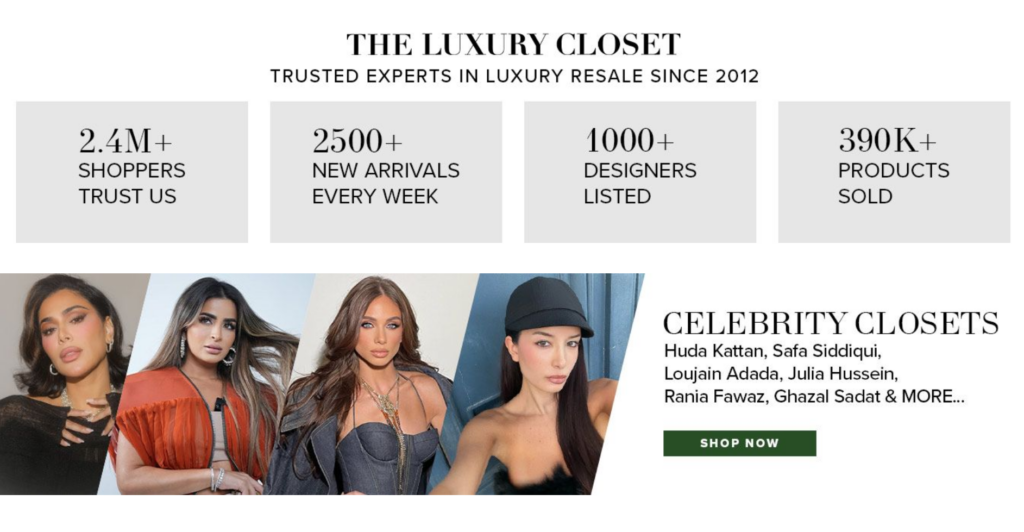
Founded in Dubai in 2012 by Kunal Kapoor and headquartered there today, with additional offices in India and Kuwait and a flagship retail store in Dubai. The Luxury Closet is said to be the largest luxury resale marketplace in the Middle East, serving clients in more than 80 countries.
Its strongest differentiator is regional infrastructure. An in-house team of more than 15 specialists, including gemologists and leather and textile experts, authenticates items. Checks cover date codes, hardware, stitching and symmetry, soles, care and composition labels, watch movements, authenticity cards and information booklets, and gemstone grading, depending on the category. The company also backs every sale with a lifetime authenticity guarantee. Buyers can find established luxury houses — Louis Vuitton, Chanel, Rolex — at an average discount of around 60% off original retail, depending on the item, condition, and current listing.
For GCC shoppers and consignors, the practical advantage is proximity: authentication, customer service, and logistics are managed from within the region, rather than routed through a distant international hub. On the selling side, consignors earn 65-85% of an item’s value, receive a quote within roughly three to five business days of submission, and are paid out on the 5th or 20th of the month. Listing periods run 90 days for UAE-based sellers, 180 days for sellers elsewhere, and 365 days for sellers in Italy.
Best for: GCC buyers and sellers who value regional infrastructure, authenticated luxury, and managed consignment.
2. Vestiaire Collective — Best for Global Vintage, Archival Fashion, and Seller-Set Pricing

Launched in Paris in 2009, Vestiaire Collective has built a large international peer-to-peer marketplace around pre-owned fashion, and it’s particularly strong for vintage, archival, and harder-to-find designer pieces, with more than 13,000 labels represented.
What sets it apart from managed-consignment platforms is control: sellers submit their own photos, item description, and condition notes, and — unlike fully managed consignment models — set their own asking price rather than accepting a platform-determined quote. That makes it a natural fit for sellers who know a piece’s market value and want to price it themselves, though it also means sellers take on more of the listing workload than they would with a consignment service.
The company publishes dedicated circularity and impact reporting. In 2025, it reported that its community gave 2.4 million items a second life, collectively avoiding an estimated 60,000 tonnes of CO2e. It has also launched a carbon credits program linked to its transaction data and verified by the third-party firm Inuk, though its credited emissions don’t cover every aspect of the platform’s operations, including shipping, packaging, and authentication.
For GCC buyers, international shipping means you need to check the final landed cost carefully—confirm customs duties, delivery timelines, and any applicable charges before completing an order.
Best for: Buyers and sellers who want global choice, European vintage and archival fashion, and control over listing price.
3. The RealReal — Best for Full-Service US and UK Consignment

The resale platform describes itself as the world’s largest online marketplace for authenticated resale luxury and reports more than 40 million members. It also operates 15+ brick-and-mortar locations across the US, including a West Hollywood store with a dedicated handbag vault.
Its model is particularly attractive to sellers who want a fully managed resale process. An in-house network of gemologists, horologists, and brand specialists authenticates items across categories including fine jewelry, watches, and womenswear, while the platform handles photography, listing, pricing, and other consignment steps for the seller.
Sellers can earn up to 85% of an item’s sale price, and in-person consignors at retail locations can get paid on the spot, with free valuations available in person or via video. The trade-off is geography: operations are primarily centered on the US and UK, making it a more natural choice for sellers and buyers in those markets than for someone based in the GCC. International customers should confirm category and location eligibility, plus delivery costs and duties, before selling or buying.
Best for: Sellers who want a fully managed consignment experience, particularly in the US and UK.
4. eBay — Best for Breadth, Auction-Style Pricing, and Free Authentication
eBay remains one of the widest-reaching resale marketplaces for luxury goods, spanning designer handbags, ready-to-wear, footwear, jewelry, and watches from houses including Chanel, Hermès, Louis Vuitton, Gucci, and Balenciaga. Its filtering — by brand, silhouette, size, color, condition, and price range — makes it practical for buyers hunting a specific item rather than browsing a curated edit.
Its key differentiator is the Authentication Guarantee, which applies to eligible luxury handbags and other categories at no extra cost to buyer or seller. Items go through a physical, multi-point inspection by trained authenticators and ship via secure, signature-required delivery; authenticated handbags receive an NFC-enabled card with the item’s verification details.
For sellers, eBay charges a final value fee only once an item sells, and payouts land directly in a seller’s bank account within about two business days after the buyer pays, Monday through Friday. Because listings are user-generated rather than platform-curated, condition and pricing consistency vary more than on managed-consignment sites, so buyers should read listings and photos closely.
Best for: Buyers seeking the widest selection and competitive, auction-style pricing; sellers who want to list independently and pay fees only on completed sales.
5. Rebag — Best for Instant Quotes and Trade-In Value

Founded in 2014 and based in New York, Rebag operates both online and through retail stores in New York, Florida, and California (including a location at The Shops at Santa Anita). It carries more than 25,000 items, with particular depth in Cartier, Chanel, Christian Dior, Gucci, Hermès, and Louis Vuitton.
Rebag’s standout feature is speed and transparency around valuation. Its Clair AI tool — available via image recognition or guided search on iOS and Android — gives an instant resale-value estimate for bags, watches, jewelry, and accessories from around 50 popular luxury brands before a seller commits to anything. Once a seller accepts a quote, Rebag sends a prepaid shipping label (or accepts in-store drop-off), and payment typically follows within three to ten business days after Rebag’s in-house specialists receive and vet the item.
Beyond straightforward buying and selling, Rebag offers a trade-in model that lets shoppers buy and sell in one transaction, a Rebag+ membership with preferential pricing and free shipping/returns, and an Infinity Exchange program that lets a buyer use a bag for up to 12 months, then exchange it for 70-80% of its purchase price as credit toward the next piece.
Best for: Sellers who want an instant, tech-driven valuation and a fast payout, and buyers interested in trade-in or exchange models.
6. HEWI — Best for Curated Sustainable Handbags and Accessories

Hardly Ever Worn It is where the name HEWI comes from. It is a UK-based resale platform focused on sustainable, pre-owned luxury, with a catalog concentrated on handbags, shoes, and accessories from houses including Chanel, Louis Vuitton, and Prada. Every listing is authenticated, and the platform offers a money-back guarantee if an item is later found to be inauthentic.
HEWI doesn’t compete with the biggest marketplaces on sheer volume. Its appeal lies in a tighter, curated edit — useful for shoppers who’d rather browse a small, vetted selection than scroll thousands of listings. International shoppers should factor in UK-origin shipping times and costs before purchasing.
Best for: Buyers who prefer a curated selection of pre-owned designer handbags, shoes, and accessories.
7. What Goes Around Comes Around — Best for Vintage and Archival Designer Pieces

Founded in New York City in 1993, What Goes Around Comes Around (WGACA) was among the first boutiques to specialize in designer vintage, and it now operates both an online platform and retail locations in New York and Beverly Hills. Its catalog spans Chanel, Christian Dior, Fendi, Goyard, Gucci, Hermès, Judith Leiber, Louis Vuitton, Prada, Rolex, Saint Laurent, and Versace, across bags, jewelry, watches, accessories, and home goods. The company describes its process as a proprietary, multi-tiered system in which an in-house team evaluates each piece three times before listing, sourcing internationally from private clients in Europe, specialty collectors in Asia, and dealers worldwide.
Best for: Buyers and sellers interested in vintage and archival designer pieces — and a reminder to verify what any platform’s “authenticity” claim actually covers.
8. Fashionphile — Best for Handbags, Fine Jewelry, and Instant Buyout Pricing

Founded in 1999 and based in Southern California, Fashionphile is one of the longest-running names in online luxury resale and has drawn investment from Neiman Marcus, which now sells Fashionphile inventory through in-store Neiman Marcus locations alongside Fashionphile’s own showrooms. Its focus is narrower than generalist marketplaces — handbags, fine jewelry, watches, and small leather goods, rather than ready-to-wear — with strong depth in Balenciaga, Bottega Veneta, Chanel, Christian Dior, Fendi, Gucci, Hermès, Louis Vuitton, Prada, and Saint Laurent.
Fashionphile authenticates every item in-house through a brand-specific process that examines textiles, hardware finishes, font styles, and construction before listing anything for resale. For sellers, it offers two distinct paths: an instant buyout, where Fashionphile makes a one-time cash offer reflecting current resale demand and pays out shortly after authentication clears, with no additional commission deducted from that price; or consignment, where Fashionphile lists the item at a higher target price and pays the seller once it sells, under a tiered commission of roughly 30% on the first $3,000 of the sale price and 15% on any amount above that. You can take either payout as store credit or a Neiman Marcus gift card for a 10% bonus. Items found not to be authentic are returned to the seller, subject to an authentication fee.
Best for: Sellers who want to choose between an instant cash buyout and a higher, slower consignment payout, and buyers focused specifically on handbags, jewelry, and watches.
Luxury Resale Websites Compared
| Platform | Headquartered | Best For | Authentication Model | Selling Model | GCC Accessibility |
|---|---|---|---|---|---|
| The Luxury Closet | Dubai, UAE | GCC buyers and sellers | 15+ in-house specialists; lifetime authenticity guarantee | Managed consignment | Regional authentication, logistics, and support |
| Vestiaire Collective | Paris, France | Vintage and archival fashion; seller-set pricing | Expert verification, in-person authentication centers | Peer-to-peer marketplace | Ships internationally; confirm duty at checkout |
| The RealReal | San Francisco, USA | Full-service US/UK consignment | In-house gemologists, horologists, brand specialists | Managed consignment | US/UK-centric logistics; confirm eligibility |
| eBay | San Jose, USA | Breadth and auction-style pricing | Authentication Guarantee: physical multi-point inspection | Seller-listed marketplace | Ships internationally; confirm duty at checkout |
| Rebag | New York, USA | Instant quotes, trade-in value | AI-assisted valuation plus in-house specialist inspection | Direct buy/trade-in | US-centric; confirm shipping and duties |
| HEWI | United Kingdom | Curated handbags and accessories | Authenticated listings with money-back guarantee | Resale | UK-origin shipping |
| What Goes Around Comes Around | New York, USA | Vintage and archival pieces; verify authenticity claims | In-house team, proprietary 3-stage authentication | Consignment/retail | US-centric; confirm shipping and duties |
| Fashionphile | Southern California, USA | Handbags, fine jewelry, watches | In-house brand-specific authentication | Buyout or consignment | US-centric; confirm shipping and duties |
Fees, shipping charges, and seller commissions can change by market, category, and transaction. Always check a platform’s current terms before committing to a purchase or consignment.
A Few Real-World Illustrations to Be Conscious About
Authentication claims are only as strong as the process behind them. Even established resale platforms have faced documented disputes over counterfeit goods and authenticity claims.
Trademark disputes over authenticity claims. In one widely reported case, a court ruled against a resale platform after finding that it had sold counterfeit goods and that its marketing implied a formal relationship with a luxury brand that did not exist. The brand was awarded multi-million-dollar damages, and the platform was restricted from using the brand’s trademarks in certain marketing. The case highlights an important distinction: a platform’s own authentication process is not the same as brand endorsement. Before buying, check who performs the authentication, what the guarantee covers, and what recourse you have if authenticity is later disputed.
Internal records revealing counterfeit listings. In another case, a resale platform faced a lawsuit alleging it sold counterfeit luxury goods through its marketplace. Investigative reporting later revealed internal records showing that counterfeit items across several brands had been listed, then identified and returned, despite the platform’s public claims that every item was authenticated. The company maintained that its authentication process was rigorous and continually improving.
The takeaway: Authentication can significantly reduce risk, but it cannot eliminate it entirely. Whether you’re buying or selling, check who authenticates, what the guarantee covers, and what happens if an item’s authenticity is later challenged.
What to Check Before Buying Pre-Owned Luxury Online
Price is only one part of the decision. Before buying a pre-owned designer piece, check:
- Authentication. Find out who authenticates the item and whether the platform explains its process. Category-specific expertise matters — handbags need leather and construction knowledge, while watches and jewelry require specialist gemological or horological expertise.
- Condition. Don’t rely on a single condition label. Examine photographs closely for scratches, stains, hardware wear, odor, missing accessories, and previous repairs.
- Returns. Understand the return window, whether returns are accepted for your destination, and whether shipping costs are refundable.
- Fees. Check whether the displayed price includes buyer fees, shipping, taxes, or other charges.
- Customs and duties. For cross-border purchases into the UAE, Saudi Arabia, or Kuwait, determine whether applicable duties are calculated at checkout or assessed on arrival.
- Authenticity guarantee. A platform’s authentication process and its guarantee are different things. Check what protection the guarantee actually provides and how long it remains valid.
A platform can have a sophisticated sustainability page and still leave basic questions about returns or landed cost unanswered. A polished environmental narrative isn’t the same thing as practical transparency.
Where to Sell Designer Clothes and Luxury Fashion Online
Sellers have different priorities. Before choosing a platform, compare:
- Commission and seller fees
- Expected payout timing
- How valuation is determined
- Authentication process
- Photography and listing services
- Shipping arrangements
- What happens if an item doesn’t sell
- Customer support
- Whether the platform accepts sellers from your country

Managed consignment platforms such as The Luxury Closet and The RealReal handle authentication, pricing, photography, and listing on the seller’s behalf in exchange for a commission — attractive for sellers who want a hands-off experience.
Peer-to-peer marketplaces such as Vestiaire Collective and eBay give sellers more control over pricing and listing content, but require managing more of the process directly.
Instant-valuation platforms such as Rebag sit in between: a fast, tech-assisted quote followed by a payout once the item is inspected, without the seller writing their own listing. For GCC-based sellers, a regionally based consignment platform can also simplify the logistics of getting an item to its authentication hub and communicating with support.
Is Luxury Resale Actually Sustainable?
The short answer: it can be, but the details matter. Keeping a well-made handbag, watch, piece of jewelry, or designer garment in use for another owner extends its productive life and reduces the need to manufacture an equivalent new product. But resale doesn’t automatically eliminate environmental impact — transportation, packaging, authentication, warehousing, refurbishment, and returns all still consume resources, which is why sustainability claims should be assessed alongside the practical mechanics of resale.
Before taking a platform’s sustainability claim at face value, ask whether it publishes its methodology, what emissions it includes, whether the calculation covers the entire transaction or only selected stages, and whether it clearly distinguishes independent studies from its own estimates. This is also why the 42% and 90% figures cited earlier shouldn’t be treated as competing universal truths — they measure different things using different methodologies. The most defensible conclusion is simpler: extending the life of an existing luxury product can be environmentally preferable to producing a new equivalent, but the size of that benefit depends on how the transaction is conducted and measured.
Sources and Methodology
We checked every market statistic and sustainability figure in this article against company reports, investor disclosures, and third-party market research available at the time of publication. Our sources include:
- ThredUp’s 2026 Resale Report (with GlobalData)
- Chalhoub Group’s GCC circularity research
- Vestiaire Collective’s Circularity Report and 2025 impact reporting
- The RealReal’s 2025 Resale Report and investor disclosures
- eBay’s Authentication Guarantee program documentation
- Rebag’s seller and Clair AI documentation
- Fashionphile’s seller terms, buyout, and consignment documentation
- Court filings and legal reporting on Chanel, Inc. v. The RealReal (filed 2018) and Chanel, Inc. v. What Goes Around Comes Around, including coverage from The Fashion Law, Business of Fashion, WWD, and Glossy
- CNBC’s 2019 investigation and reporting on The RealReal’s internal “Faux and Tell” authentication records
- A 2023 lifecycle study published in the Journal of Circular Economy
We attribute platform-specific claims about scale or standing — such as “largest” or “first” — to the platform’s own description unless an independent source supports the claim. We also flag, in the relevant sections above, where sustainability figures from different organizations use different methodologies and therefore aren’t directly comparable.